Research, innovation, health policy and real-world implementation. microscopIA connects people, evidence and technology to help organizations address complex healthcare challenges.
Two programs. One ambition: connect clinical research, engineering, and economics to help improve how health systems deliver care.
COLOMBIA · GLOBAL
Building evidence for critical care systems people can reach.
We connect population needs, ICU locations, and travel times to identify gaps that facility counts alone cannot reveal. Starting with Colombia, our international agenda aims to inform referral networks, transport, and investment in accessible critical care.
FEATURED WORK · PUBLIC PREPRINT
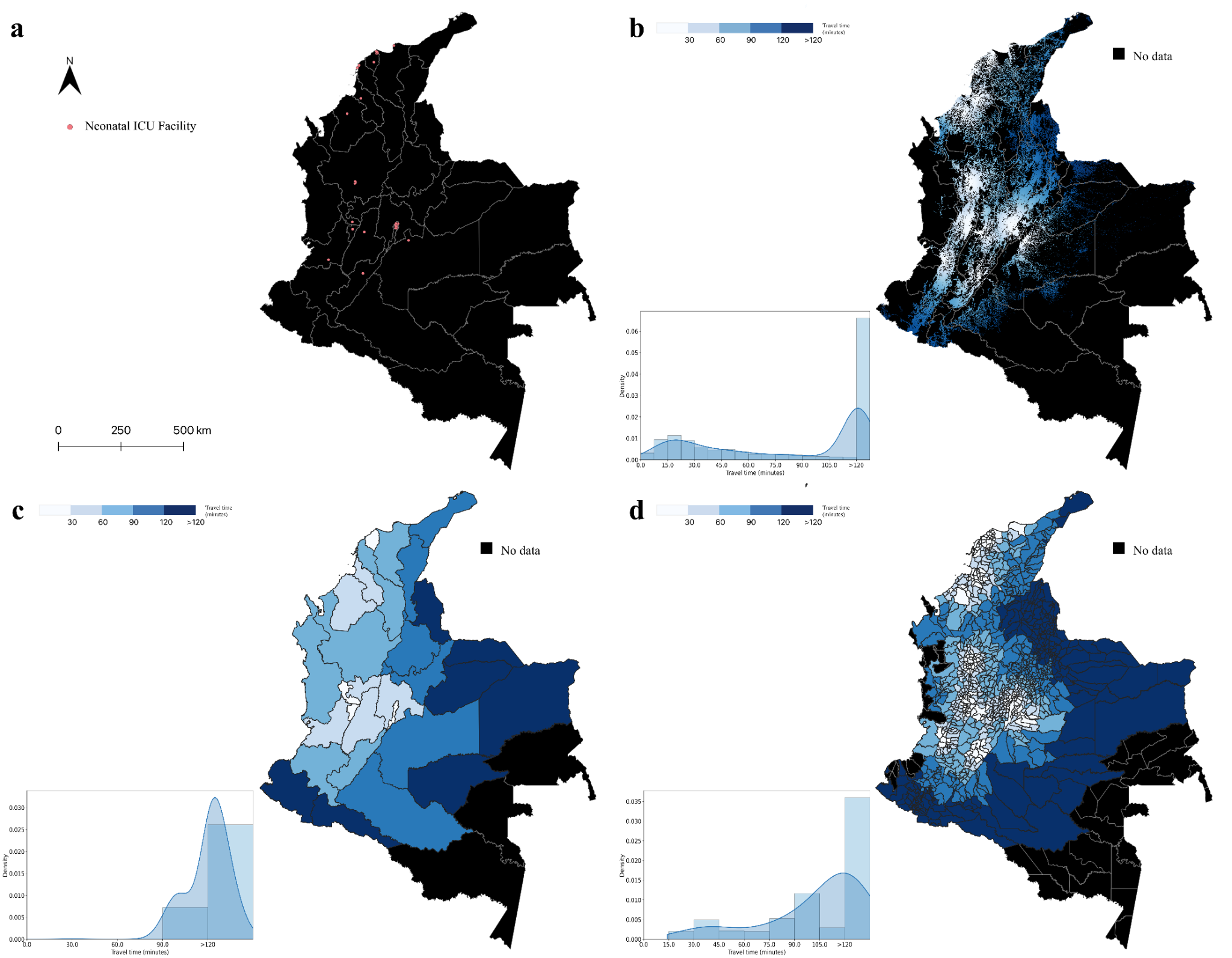
Geographic access to intensive care in Colombia
51.0% of the modeled population lives more than 2 hours from neonatal ICU.
Public preprint. The maps model geographic access, not current staffing, available beds or quality of care. International application requires local data and validation.
Neonatal ICUMain study figure · Quintero Villarreal et al., 2026 · CC BY 4.0How to read the figure
A · Facility locations. B · National travel times. C · Department averages. D · Municipality averages.
Travel-time scale: 30, 60, 90, 120, and over 120 minutes, from light to dark blue. Black: no estimate in panels B–D.
AI-generated editorial illustration
PRELIMINARY RESEARCH · PREPRINTS
Generating evidence to help prevent childhood blindness worldwide.
We evaluate early-stage ROP prophylaxis and associated clinical and economic outcomes in real-world studies. We analyze access to ROP-trained ophthalmologists for screening, treatment or both, and advance research in AI and neonatal eye-care devices.
FEATURED WORK · PUBLIC PREPRINT
Clinical outcomes in early-stage ROP
Retrospective research on progression to treatment-requiring disease. Observed associations require prospective validation.
Preliminary research. These findings do not establish long-term blindness prevention or justify routine adoption of the investigated topical treatments.
Explore the available studies
Progression to treatment-requiring ROP
We evaluated real-world use of topical ketorolac or nepafenac alongside surveillance in stage 1–2 ROP, asking whether it was associated with less progression to disease requiring laser ablation or anti-VEGF therapy. This was not prevention of ROP onset, and long-term blindness prevention was not established.
Public preprints have not completed peer review. Source verification does not establish clinical benefit.
THE PEOPLE BEHIND THE WORK
Different disciplines. Shared challenges.
Clinical insight, engineering, economics and community experience belong in the same conversation. Meet the people contributing to microscopIA and explore their expertise, roles and scientific work.
City-level professional locations, not offices, study sites or clinical coverage. External affiliations identify individuals and do not imply institutional partnerships.
FOR YOUR ORGANIZATION
A scientific partner for your next challenge.
Turn clinical questions into structured research.
Potential project scope
Study design · Biostatistics · Research coordination · Manuscript development
Physical research prototype · Intended-use validation still required
Technology in development
Engineering that starts with a real need.
Our physical automated-microscopy prototype explores image acquisition and software-assisted sample review for malaria research. It brings devices, imaging and clinical expertise into one development pathway.
Choose a pathway to understand its requirements and your next step.
No mandatory membership
As an external participant
Apply to eligible mapping projects without mandatory membership. Receive training and contribute to agreed scientific tasks. Selection depends on eligibility and places.
Build a research pathway with a suitable supervised assignment, training and plan-specific benefits. Compare Students & Young Professionals and Clinicians & Investigators categories.
Membership supports scientific and technical staff, approved research costs and community programs. Scientific selection and authorship depend on eligibility and contributions.
Your clinical expertise can open the next question.
Three calls for qualified clinicians and investigators. Proposals until 15 November 2026; review each pathway’s conditions.
Bring a clinical question and organized, authorized inputs. Our researchers contribute agreed scientific work alongside your team. Students & Young Professionals cannot lead these calls. Already a professional member? No second membership purchase is needed.
Active professional members only
Clinical images & AI
You bring
An organized collection of authorized images, reliable labels and clinical supervision.
We contribute
Research design, model development and validation within an approved protocol.
Our psychological-support pilot via telemedicine aims to reduce barriers to care for people and communities, with an international outlook and sessions in English and Spanish.
Free for people aged 65+ and eligible citizens or residents of low-income economies.
Free pilot through November 30, 2026. From December 1: USD 5 per session; the exemptions above continue.
Preprints, observational findings and prototypes have different limits. Research findings are not clinical recommendations.
Agree on responsibilities
Scientific review, data permissions, ethics requirements and contributions guide each approved collaboration. Membership does not guarantee authorship.
Understand the commitment
Review eligibility, project fees, publication support and timelines before applying. Journal acceptance remains an independent decision.
microscopIA
A relevant question deserves a prepared team.
Discuss a scientific or technology collaboration with defined objectives, responsibilities and resources.